

This plan aims to ensure gender equality, increase the security of vulnerable groups, and increase opportunities for equal social and economic participation in all phases of the Ulaanbaatar Metro project, in line with the principles and requirements of organizations such as the International Finance Corporation (IFC), the World Bank (WB), the Asian Development Bank (ADB), the Asian Infrastructure Investment Bank (AIIB), and the European Bank for Reconstruction and Development (EBRD).
In Ulaanbaatar, women travel short distances between work, school, shopping, and healthcare facilities, often with children or elderly family members. This increases women’s travel time and makes them more dependent on accessible, safe, and reliable public transportation. Compared to men, women travel less by private vehicle, and are more likely to rely on buses, walking, and informal transportation.
However, the safety, security, and convenience of Ulaanbaatar’s public transportation system remain a constant concern for women. Women are particularly affected by the problem in the early morning and evening hours, when public transport services are limited, lighting is poor, and control systems are weak.
Therefore, the Ulaanbaatar Metro project aims to increase the right of women, children, the elderly, and people with disabilities to travel on safe, reliable, and accessible public transport, and, implicitly, to increase equal participation in society and employment opportunities. These include:
Design phase - Involve women and vulnerable passengers in the planning phase of the basic infrastructure and incorporate their feedback into the design (e.g. ramps, lifts, tactile paths, facilities for elderly and children passengers, safety in winter conditions (snow and ice)
Construction phase - Ensure employee well-being, actively promote employment equality, and implement grievance mechanisms to create a gender-neutral and safe work environment (e.g. gender balance in the workplace, 100% participation in sexual harassment and gender-based violence training, 10–15% women in technical positions, etc.)
Operation phase - Regularly monitor and evaluate whether all customers can safely and equally participate, and based on this, improve operations in a timely manner (e.g. installation of emergency call systems, 100% provision of CCTV and lighting, employment of female security guards, etc.)
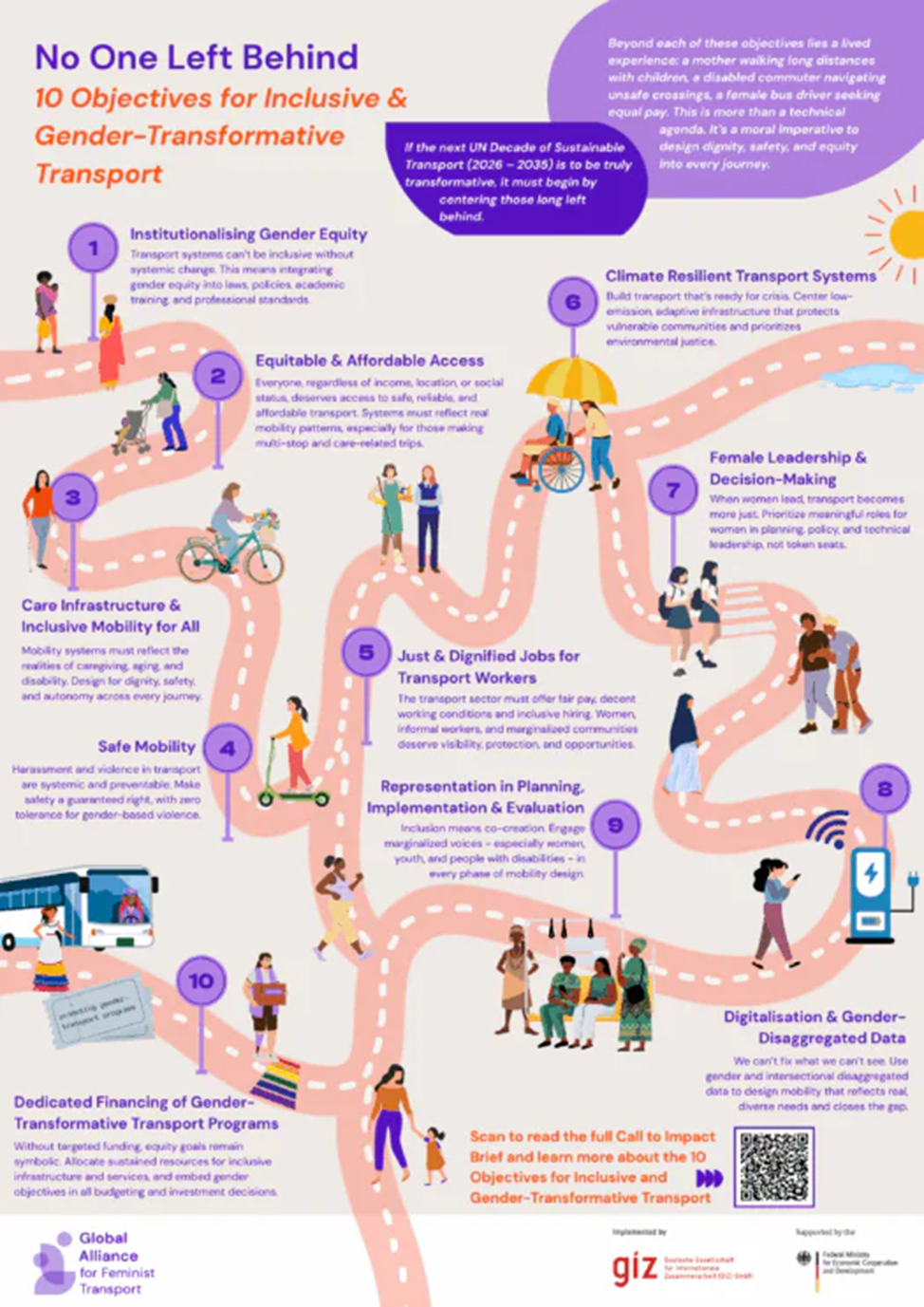 Key Objectives:
-Enable safe and accessible transportation
-Increase women's employment and participation
-Protect women's sources of income
-Prevent gender-based violence
-Increase women's participation in project decision-making