

This plan aims to manage traffic congestion, delays, and safety risks arising during the construction phase of the Ulaanbaatar Metro Project, while maintaining safe and efficient mobility for all road users.
As the project is implemented along highly congested urban corridors, traffic impacts are significant. This plan serves as a key operational document under the ESIA and ESMP frameworks.
-Peak hour speed: 7–13 km/h
-Volume-to-Capacity Ratio (VCR): 1.7–2.2 (severely overloaded)
-Level of Service (LOS): LOS F (oversaturated)
*Examples:
-Sapporo intersection: 7,200 PCU/hr, 70 sec delay
-Officer Roundabout: 8,056 PCU/hr, 94 sec delay
-Narantuul: 114 sec delay
-Modal split:
*Private vehicles: 65.2%
*Public transport: 23.1%
*Pedestrians: ~12%
-Bus system:
*589 buses / 61 routes
*51,000–74,000 passengers/day
This Traffic Management Plan (TMP) establishes a comprehensive framework to ensure safe, continuous, and efficient traffic flow throughout all construction phases of the Ulaanbaatar Metro Project. It defines measures to identify, avoid, minimize, and manage traffic-related impacts arising from construction activities.
Given that the Project is implemented within highly congested urban corridors with limited road capacity, the TMP prioritizes maintaining traffic flow without full road closures by adopting a phased traffic management approach.
Prior to the commencement of construction, detailed traffic surveys shall be conducted to establish baseline conditions, including traffic volumes, intersection capacity, traffic flow characteristics, and pedestrian movement patterns.
Based on these findings, construction sequencing and staging plans shall be developed to avoid simultaneous lane closures in adjacent sections or intersections. Traffic flow shall be maintained as close to normal conditions as possible.
High-impact activities, including large-scale excavation, heavy material transport, and operation of heavy vehicles, shall be scheduled during off-peak hours to minimize disruption.
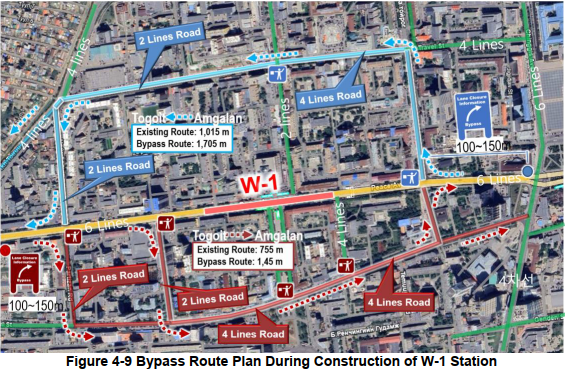
Temporary Traffic Control (TTC) systems shall be established at all construction sites to ensure clear guidance and safe movement for all road users.
The TTC layout shall consist of four functional zones, including an advance warning area to inform road users, a transition area to guide traffic into a new alignment, an activity area where construction takes place with appropriate buffer separation, and a termination area where traffic returns to normal flow conditions.
All traffic control devices, including signs, cones, barriers, lighting, and information boards, shall be installed in accordance with international standards and maintained in good condition to ensure visibility during both daytime and nighttime operations.
Construction activities shall be implemented using a carefully planned multi-stage traffic phasing strategy to minimize disruption and avoid complete road closures.
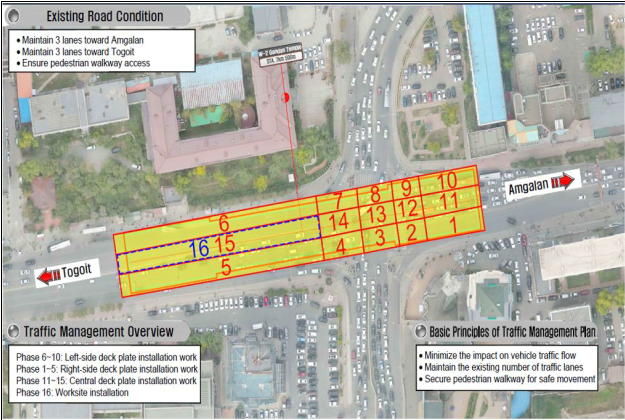
This approach is based on utilizing available road width in segments and progressively shifting construction activities across the carriageway while maintaining traffic flow.
For midblock sections, construction shall be carried out in sequential stages, beginning with works on one side of the road while traffic is diverted to the remaining lanes. In subsequent stages, construction activities shall be shifted to the opposite side, with traffic flow adjusted accordingly. In the final stage, works shall be undertaken in the central section, with traffic distributed on both sides.
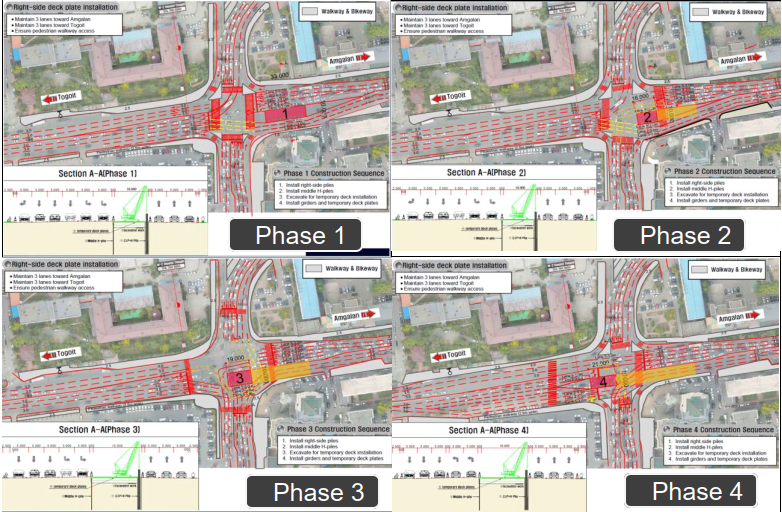
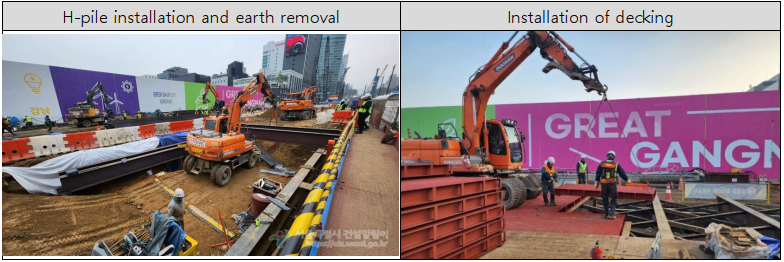
Throughout all stages, road capacity shall be maintained as much as practicable, and temporary adjustments such as reduced lane widths or modified lane configurations may be applied where necessary.
At intersections, construction shall be carried out using multi-phase sequencing, whereby work is undertaken in one portion of the intersection at a time while maintaining traffic flow in the remaining sections. Where required, temporary traffic signals, manual traffic control, and restrictions on turning movements shall be implemented to manage flow effectively.
Where road width is insufficient, contraflow arrangements may be introduced, allowing temporary use of opposing lanes. These arrangements shall be implemented only where safety requirements are fully satisfied and shall include physical separation using barriers and clear signage.
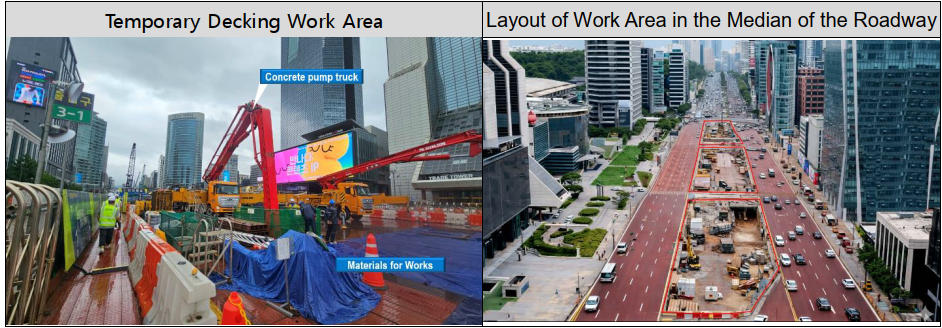
Traffic diversion strategies shall also be implemented to redistribute traffic demand to alternative routes, including parallel roads and secondary streets. These routes shall be assessed in advance for capacity and suitability and shall be clearly marked and communicated to road users.
During transitions between stages, new traffic control measures shall be installed prior to removing existing arrangements, and traffic shall be gradually shifted using controlled and monitored procedures to minimize confusion and safety risks.
Throughout the construction period, the Project shall maintain at least 70% of the existing road capacity on key corridors.
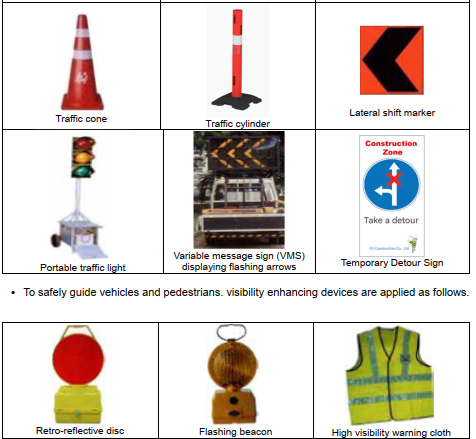
In situations where maintaining lane capacity is not feasible, alternative measures such as contraflow operations, temporary diversion routes, and adaptive traffic signal control shall be implemented.
Signal timings shall be optimized to prioritize dominant traffic flows and reduce congestion levels.
All construction zones shall be designed and managed to ensure the safety of both workers and road users.
Protective barriers, warning signage, lighting, and speed restrictions shall be implemented to minimize accident risks. Pedestrian movement shall be maintained at all times through the provision of physically separated walkways.
Traffic marshals shall be deployed at critical locations to guide traffic and ensure safe interactions between vehicles, pedestrians, and construction activities.
Public transport routes and bus stops affected by construction shall be temporarily relocated in coordination with relevant authorities.
Safe and accessible boarding areas shall be provided, and pedestrian pathways shall be maintained with a minimum width of 1.5 meters, ensuring continuity and safety for all users.
Continuous access for emergency services, including ambulances, fire services, and police, shall be maintained at all times throughout construction.
Dedicated emergency access corridors shall be clearly defined, and priority access shall be ensured through manual control and temporary signaling where necessary.
Information regarding construction activities and traffic changes shall be communicated to the public in advance using signage, digital platforms, and variable message systems.
A grievance mechanism shall be established to receive and address public concerns related to traffic disruptions.
Traffic conditions shall be continuously monitored using CCTV systems, field observations, and regular inspections.
Based on monitoring results, traffic management measures shall be adjusted in real time to respond to congestion, reduced speeds, or increased accident risks. Additional controls shall be implemented during peak hours to improve traffic flow.
Given the varying traffic conditions along the project corridor, location-specific traffic management strategies shall be applied.
More stringent and detailed control measures shall be implemented in central urban areas with high traffic demand, while more flexible approaches may be applied in outer sections of the corridor to optimize overall system performance.