Environmental Impact Assessment
Law of Mongolia on Environmental Impact Assessment, relevant regulations and methodology (A-117)
Environmental Baseline Assessment (EBA)
General Environmental Impact Assessment (GEIA)
Detailed Environmental Impact Assessment (DEIA)
Structure of the Detailed Environmental Impact Assessment Report
Non-Technical Summary
Introduction
Scope of the Activity
Project Description
Key and Potential Adverse Impacts and Assessment
Mitigation, Prevention, Reduction, Remediation, and Compensation Measures
Risk Assessment and Management
Key Findings and Overall Conclusion
Environmental Management Plan
References
Based on the Feasibility Study and the General Environmental Impact Assessment conclusion issued by the Ministry of Environment and Climate Change (Ref. No. 12/3400), the Detailed Environmental Impact Assessment (DEIA) report has been prepared for the project “Construction of a High-Capacity Public Transport System (Metro) in Ulaanbaatar City.
Research Methodology
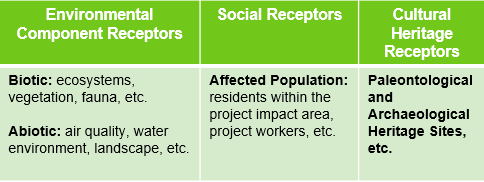
Receptors (Affected Components):
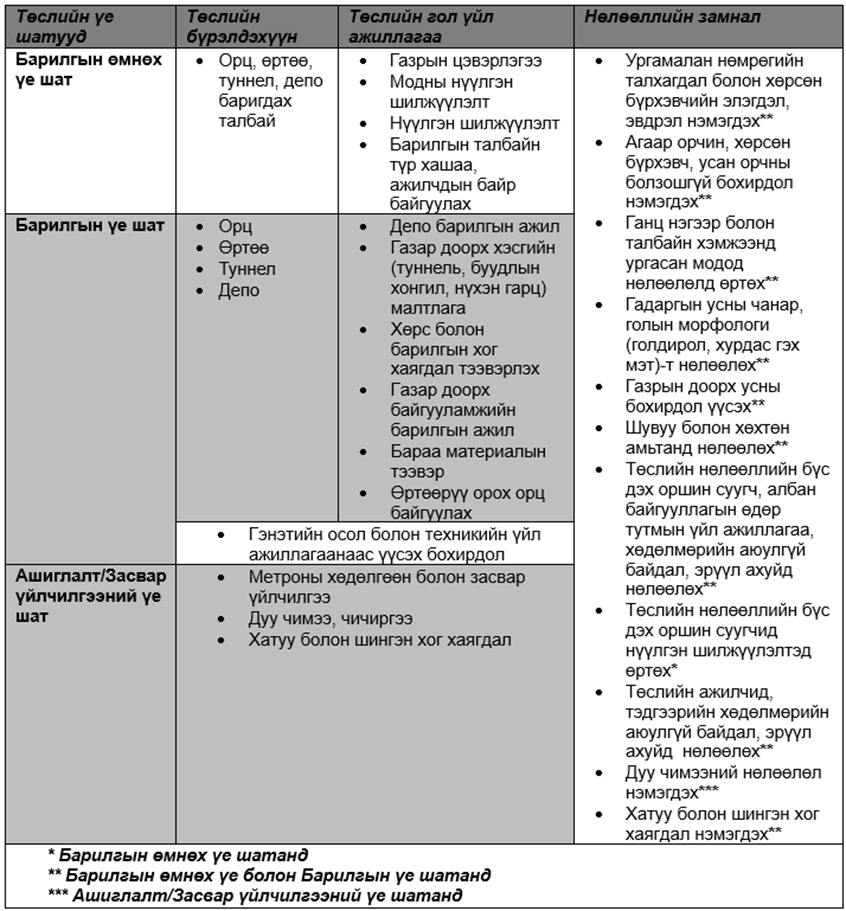
Impact Pathways of the Project:
Biodiversity:
Affected Vegetation
Within the project scope, certain sections of public green spaces along Tolgoit Road, Moscow Street, Peace Avenue, Police Academy Avenue, and Gachuurt Road will be affected. Specifically, a total area of 301,104.3 m² is planned to be impacted by the construction of metro stations along the project alignment.
Within this area, the survey identified a total of 6,337 trees and shrubs belonging to 22 species, including 3 species of coniferous trees, 2 species of deciduous trees, and 17 species of shrubs. In addition, approximately 2,248.6 meters of vegetative hedges will be affected.
Fauna: Mammals
A list of potential mammal species that may occur within the project area has been identified. In the forest and forest-steppe zones surrounding Ulaanbaatar, researchers have recorded a total of 51 mammal species belonging to 6 orders. However, in recent years, some of these species have declined or disappeared due to urbanization and human settlement expansion.
Fauna: Birds
Within one of the planned depot sites, located in a state special protected area, several commonly occurring bird species in Mongolia have been recorded. These include Black Kite (Milvus migrans), White Wagtail (Motacilla alba), Common Redstart (Phoenicurus phoenicurus), Eyebrowed Thrush (Turdus obscurus), Common Rosefinch (Carpodacus erythrinus), Yellow-browed Warbler (Phylloscopus inornatus), Lesser Spotted Woodpecker (Dryobates minor), as well as water and riparian birds such as Ruddy Shelduck (Tadorna ferruginea), Common Merganser (Mergus merganser), Mallard (Anas platyrhynchos), and Little Ringed Plover (Charadrius dubius) (Figures **).
No bird species classified as regionally or internationally rare or endangered under the Red List criteria have been identified within the designated project areas.
Water Environment – Surface Water:
Tuul River
Daily discharge measurements of the Tuul River recorded at the Tuul–Ulaanbaatar hydrological station over a 12-year period (2008–2019) indicate that the long-term average flow is 16.24 m³/s.
Uliastai River
The 1% exceedance probability (flood) discharge of the Uliastai River is estimated at 380 m³/s at the river mouth and 183.4 m³/s at the Uliastai hydrological station. Based on the calculated 1% flood discharge, the entire floodplain of the Uliastai River is expected to be inundated during such events.
Selbe River
At the calculated cross-section, the catchment area is 303.5 km², with a 1% exceedance discharge of 208.8 m³/s. Based on the relationship between water level and discharge, the corresponding water level is 1298.4 m, and overflow occurs when discharge exceeds 270 m³/s. The flow velocity is 2.8 m/s, and the cross-sectional area is 85 m².
Water samples were collected from six surface water locations and analyzed for chemical composition and heavy metal content. The results comply with the requirements of the standard “MNS 4586:2024 – Water Quality. General Requirements.”
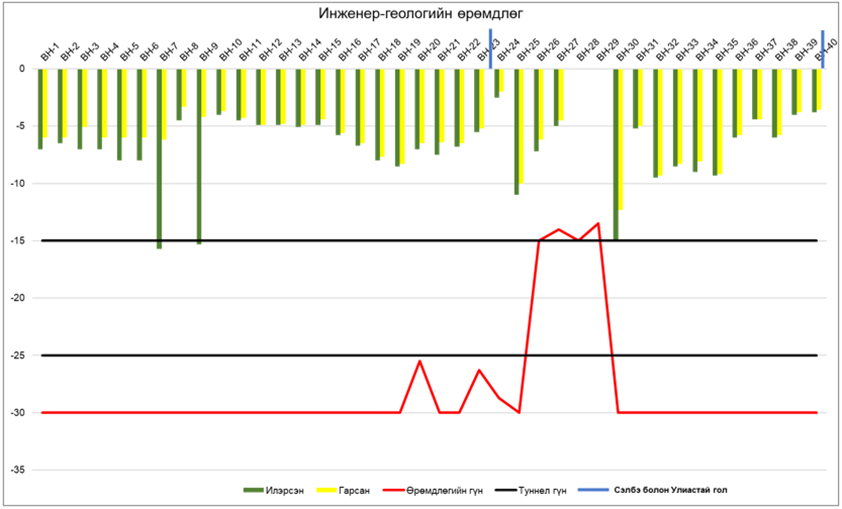
Based on the results of the conducted engineering geological drilling, the borehole depths range between 13.5 m and 30 m, with an average planned drilling depth of 30 m, while the planned tunnel depth is approximately 25 m. Borehole BH-24 is located within the Selbe River floodplain, and BH-40 within the Uliastai River floodplain.
Noise:
Noise levels were measured at 16 locations along the project alignment through 20-minute field measurements. The results were compared against the permissible limits specified in the MNS 4585:2025 standard for a 20-minute duration.
The calculated noise level during construction is 81.9 dB(A). According to modeling results, this level attenuates to 60 dB(A) at a distance of 125 meters, which complies with the daytime standard limits of MNS 4585:2025.
Historical and Cultural Heritage:
Archaeology
The study was conducted by National University of Mongolia and the Institute of Archaeology of Mongolia on September 28–29, 2025.
The survey concluded that no significant archaeological or cultural heritage remains were identified within the project area for the metro construction from Tolgoit to Khujirbulan.
Paleontology
The study was carried out by the Institute of Paleontology, Mongolian Academy of Sciences under a contract dated September 22, 2025.
The research team included Dr. D. Dorjnamjaa and researchers P. Delgerzaya and S. Khurelbaatar.
The majority of the study area is covered by Quaternary unconsolidated sediments, with smaller areas consisting of Lower Carboniferous sedimentary–terrigenous deposits. Paleontological reconnaissance surveys were conducted within these sedimentary formations, and no fossil remains of ancient flora or fauna were identified.
The conclusion states that there are no objections from a paleontological perspective to proceeding with construction activities within the project area.
Household Survey:
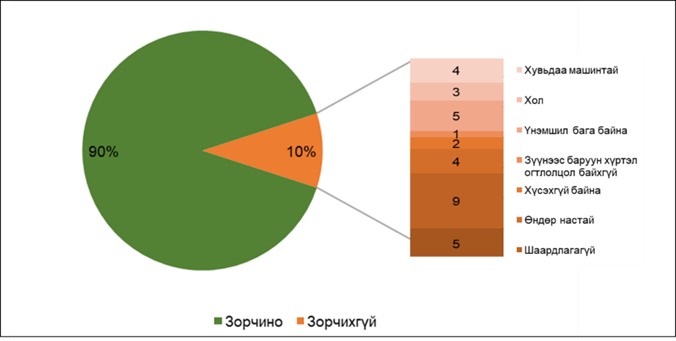
Survey results collected from residents living in 48 khoroos across 5 districts affected by the project.
Songinokhairkhan District: 42 households (12.5%)
Chingeltei District: 31 households (9.3%)
Sukhbaatar District: 15 households (4.5%)
Bayangol District: 63 households (18.8%)
Bayanzurkh District: 184 households (54.9%)
Metro Usage Needs Identified as Follows:
During traffic congestion
To save time / for time efficiency
Fast and convenient travel
In urgent situations
On license plate restriction days (when private vehicles are not allowed)
For long-distance travel
For commuting to work and completing daily tasks
Regularly / at all times / in any situation
Out of interest or curiosity
Other (e.g., returning home, dropping off children, when routes are convenient, etc.)
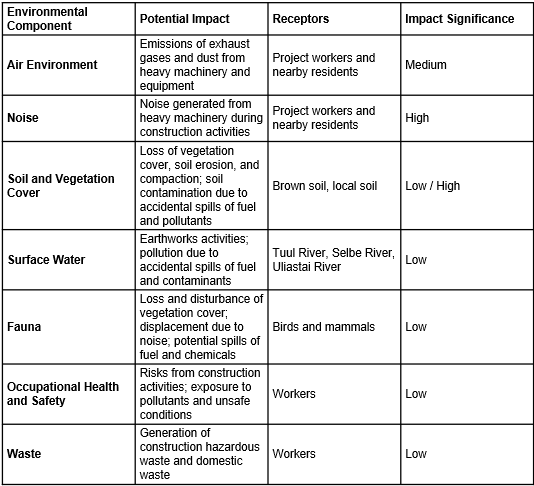
Potential Environmental Impacts of the Project (Study Findings)
Mitigation Measures for Preventing, Reducing, Eliminating, and Offsetting Adverse Impacts (by Number of Actions)
Air Quality Mitigation Measures
Preventive measures – 8
Mitigation measures – 4
Soil Protection Measures
Preventive measures – 7
Mitigation measures – 4
Biodiversity Mitigation Measures
Preventive measures – 4
Mitigation measures – 6
Water Environment Mitigation Measures
Preventive measures – 13
Mitigation measures – 4
Noise Mitigation Measures
Preventive measures – 8
Mitigation measures – 4
Waste Management Measures
Preventive measures – 7
Mitigation measures – –
Socio-Economic Mitigation Measures
Preventive measures – 10
Mitigation measures – –
Cultural Heritage Protection Measures
Preventive measures – 1
Mitigation measures – –